Supervisor observation cycle
- maryhalvorson11
- Mar 28, 2024
- 5 min read
For my supervisor observation cycle I led the dismissal to lunch. This is group B, so it is a different group from the morning group and group A does things much differently than this group. Although this was my supervisor observation cycle, I talked to my CT about how I should approach these students, since they have more energy and are more outgoing than group A. I wanted to make sure that although it was a different group, I had the same expectations that I would have with group A, and to get the students down to lunch at the correct time. During my discussion with my CT, she gave me some insight on this group. She explained that this group needs multiple reminders and typically takes an extra minute or two to line up, so we would need to start the routine 7 minutes before instead of 5.
I then had my preconference with my supervisor, we talked about how this is a different group, and I would need to really control the behavior of students. We talked about the importance of using non-verbal signals, “Cues can be quite effective in obtaining the desired behavior, but the teacher must be sure that all students understand the cue.” (Levin & Nolan 237) In my lesson I decided to use nonverbal signals in order to remind the students of my expectations without having to repeat myself or disrupt the class. I decided to put my finger over my mouth and hold up my hand with a 0 as reminders and clues that students should be silent. The hand up with a 0 is a common cue used at my school, and my CT uses the finger over the mouth as a cue in most of her lessons, so the students would understand what I mean when I did that cue. After these discussions I was ready to perform the routine.
Using the 1,2,3, eyes on my attention getter for my students.
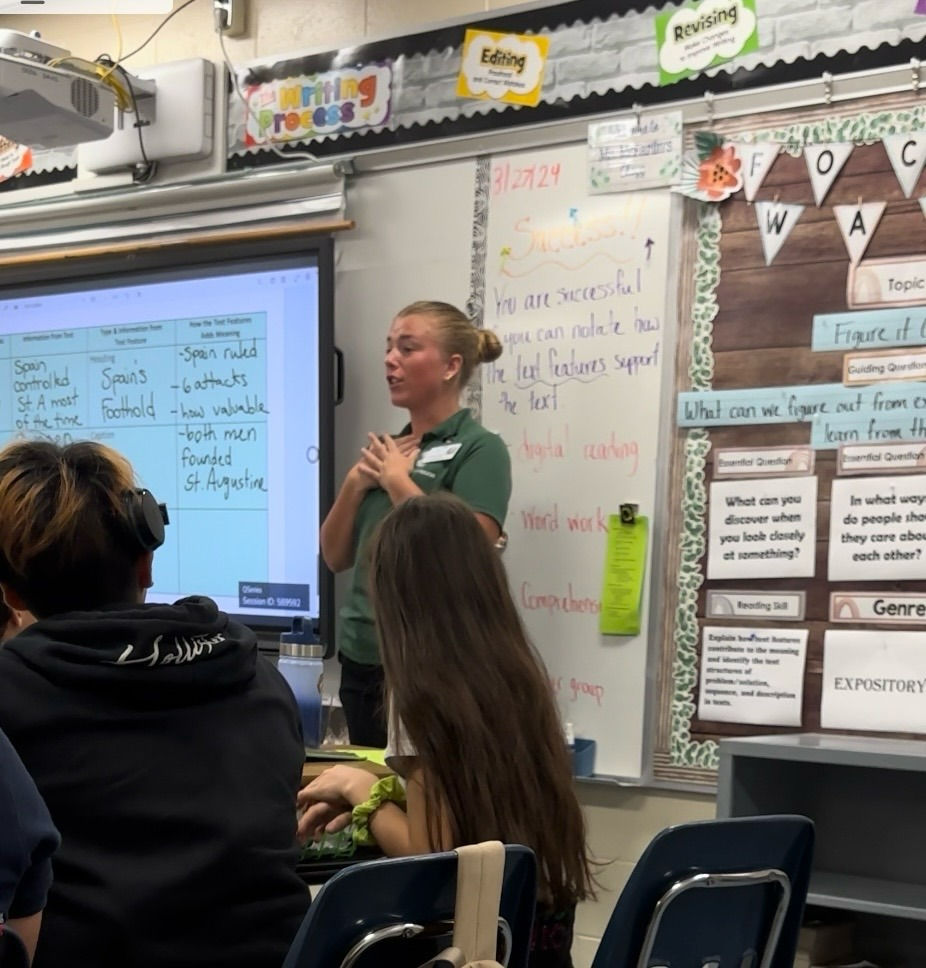
I stood up at the front of the class at 11:39, 6 minutes before we were supposed to be at lunch. I began with an attention getter, 1,2,3, eyes on me. The students immediately got quiet and turned their attention to me. I was clear with my choice of words, I made sure to include “when I say go” in order for the students to not get up until I said so. Unfortunately, a couple of students started to get up so I just had to remind them of my expectations. They then sat back down, and I was able to clearly communicate with the class, letting them know we would not get going until they were in a single file, quiet line. I reminded them to go get their lunchboxes and their lunch tags before they got in line. When I said go the students got up and got their tags and lunchboxes, they then got in line. The transition to get in line was not as quiet as I wanted, although I did not explain to them that I wanted them to be quiet while grabbing their things, just when they get in line. Once the students got in line, I assigned two door holders and a line leader for this process to go smoother. I waited for about two minutes until the students were quiet, then I signaled the students to go by waving my hand. I put my finger over my mouth and held up a 0 on my hand for the students to remind them to stay quiet in the hallway. The students walked down, stopping at the end of the stairs. I reminded students by putting my finger over my mouth that they were to stay quiet. I then waved to the line leader to go once all the students were caught up. My goal was to get students down to lunch in six minutes, and by the cooperation of the students and my reminders, we made it in less than five.
Overall, I felt like this group’s cooperation and understanding of my expectations went well. They stayed quiet, stayed in line, and kept their hands to themselves. Since I gave them clear instructions on my expectations and reminded them by using nonverbal signals, the routine went smoothly. The only thing I wish I did that may have let us get to lunch faster would be telling my students to stay quiet while getting their lunch tags and lunch box. The most important thing I learned while engaging in this routine would be the importance of nonverbal communication. I did not have to keep reminding them to be quiet, I just put my finger over my mouth, and they knew to stop talking. Doing this helped us get to lunch on time. Previous remind us that, “93% of surface-level behaviors can be dealt with effectively with a single intervention.” (Levin and Nolan 238) Which was an indication on how important an effective intervention is in the classroom.
Students lined up; I am using the nonverbal
communion by putting my finger over my mouth.

When I perform this routine next week, I will continue to use nonverbal cues as well as stating my expectations at the very beginning of the lesson. I will also include that I expect my students to be quiet while they are getting their lunch tags and lunch boxes. This will help the routine go faster and would help the distractions in the classroom. Overall, I am very happy with the results of this routine and am proud of my students for watching my nonverbal cues.
2a- I managed, organized time, space, and attention by getting my students lined up and to lunch on time. I did this by starting the routine 6 minutes before we were supposed to be at lunch. I also got the attention of my students by saying “1,2,3, eyes on me” as an attention getter at the beginning of class.
2b- I managed the individual and class behaviors by the steps and the words that I used to get them to lunch on time, in a single file quiet line. I set my expectations for the whole class right away. I also used nonverbal ques such as putting my finger over my mouth and putting my hand up in a 0 to remind students to stay quiet.
2c- I conveyed high expectations to all students by reminding them to follow the single file quiet line all the way down to lunch. I made sure they were quiet and ready to go before we started walking.
2e- I modeled the clear, oral communication tools when I communicated to the students exactly what was expected of them, and what they should be doing to go to lunch. Which was explaining they need to be in a single file quiet line before we go to lunch.
LEVIN, JAMES. Principles of Classroom Management: A Professional Decision-Making Model. PRENTICE HALL, 2021.

Comments